Slate at Founders Tower

Calculator Handbookv35

Start with a walkthrough — a full wedding, or a small corporate night, screen by screen. The reference below covers every tab, toggle and field. Search finds all of it.

CONFIDENTIAL

Slate internal only. Do not forward, share or publish this page. It carries our costs, margins and pricing strategy. It is for Slate staff and contracted team members, and nobody else.

This page is served from Slate's own domain and your connection is identifiable to it.

A

A wedding for 100, all inclusive

A Saturday wedding at Slate: 100 guests, the whole floor for the day, open bar, dinner by Chef Clayton, and the Elevated Luxe package. This is the house standard — price a variation by starting here and changing one thing at a time.

1

Start on Venue and set the frame

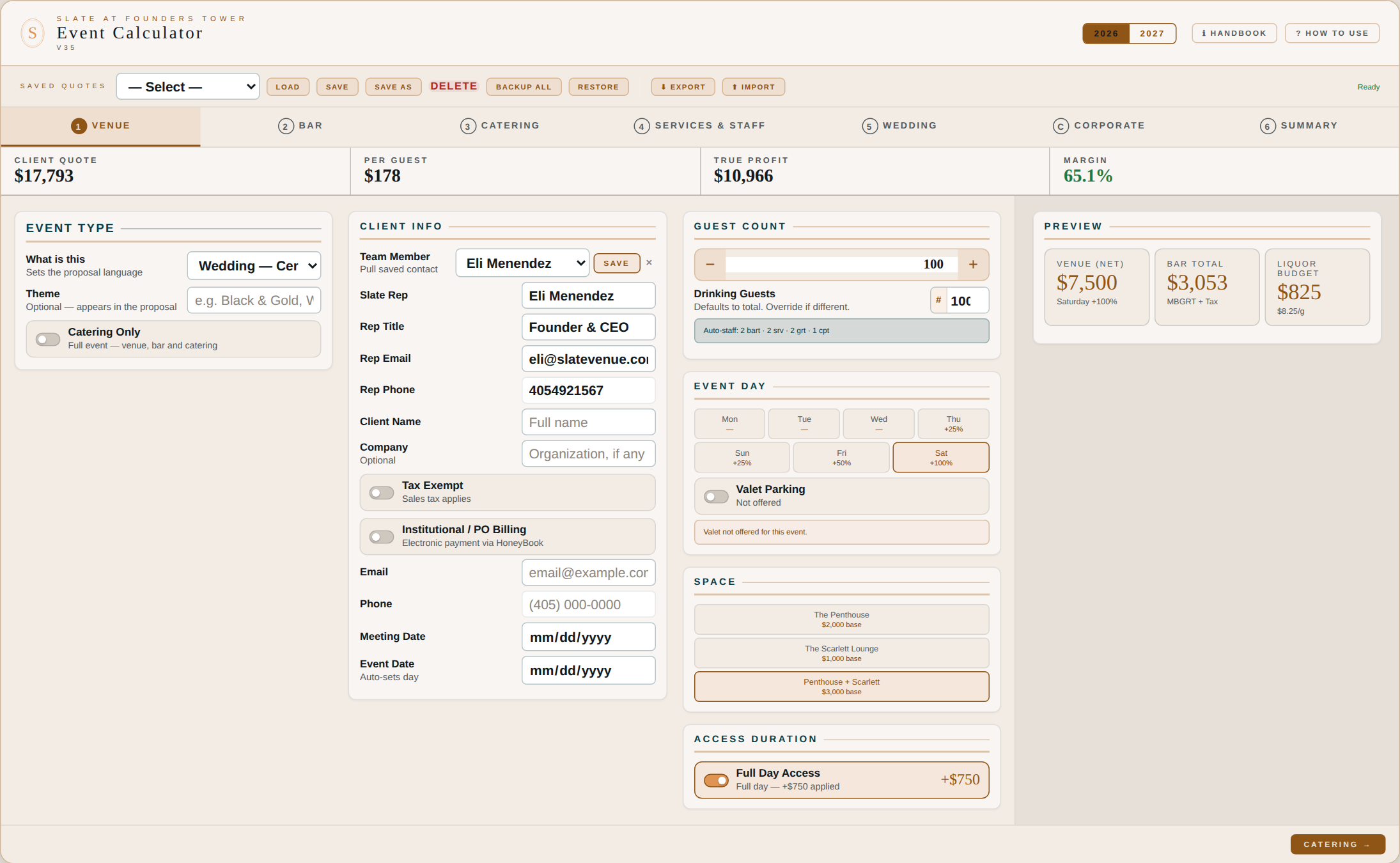
Pick the event type so the proposal reads like a wedding. Put the client’s surname in — it becomes the Proposal ID. Then set the event date: the day of the week follows from it, and the day is the single biggest lever on price. Saturday doubles the venue fee, Friday adds half, Thursday and Sunday add a quarter.

Set 100 guests, choose Penthouse + Scarlett for the full floor, and turn on Full Day Access. Leave Drinking Guests alone unless a real share of the room won’t drink.

Watch forNever pick the day by hand. Set the date and let the day follow, or you can quote a Saturday at Thursday prices.

Start on Venue and set the frame
Start on Venue and set the frameclick to enlarge
2

Bar — choose the tier, then the price

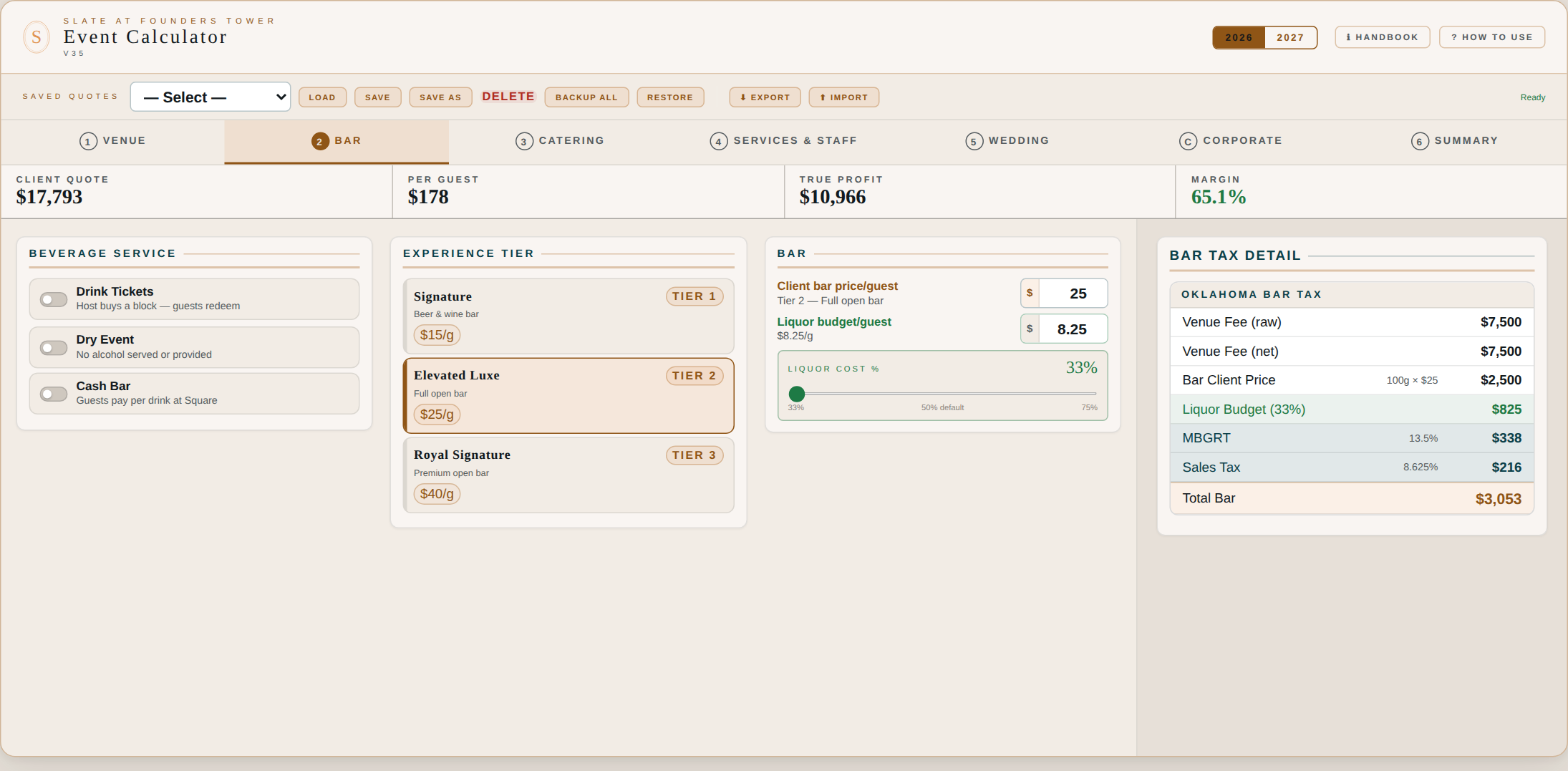
Tier 2, Full Open Bar, fills in at $25 a guest and a liquor budget of $8.25. The tier sets those numbers; edit them afterwards if this couple negotiated something different. Changing the tier resets both, so pick the tier first.

Watch forThe liquor budget is what Slate expects to spend, not what the client sees. It is what decides the Bar centre’s margin.

Bar — choose the tier, then the price
Bar — choose the tier, then the priceclick to enlarge
3

Catering — Slate kitchen, Dinner Experience

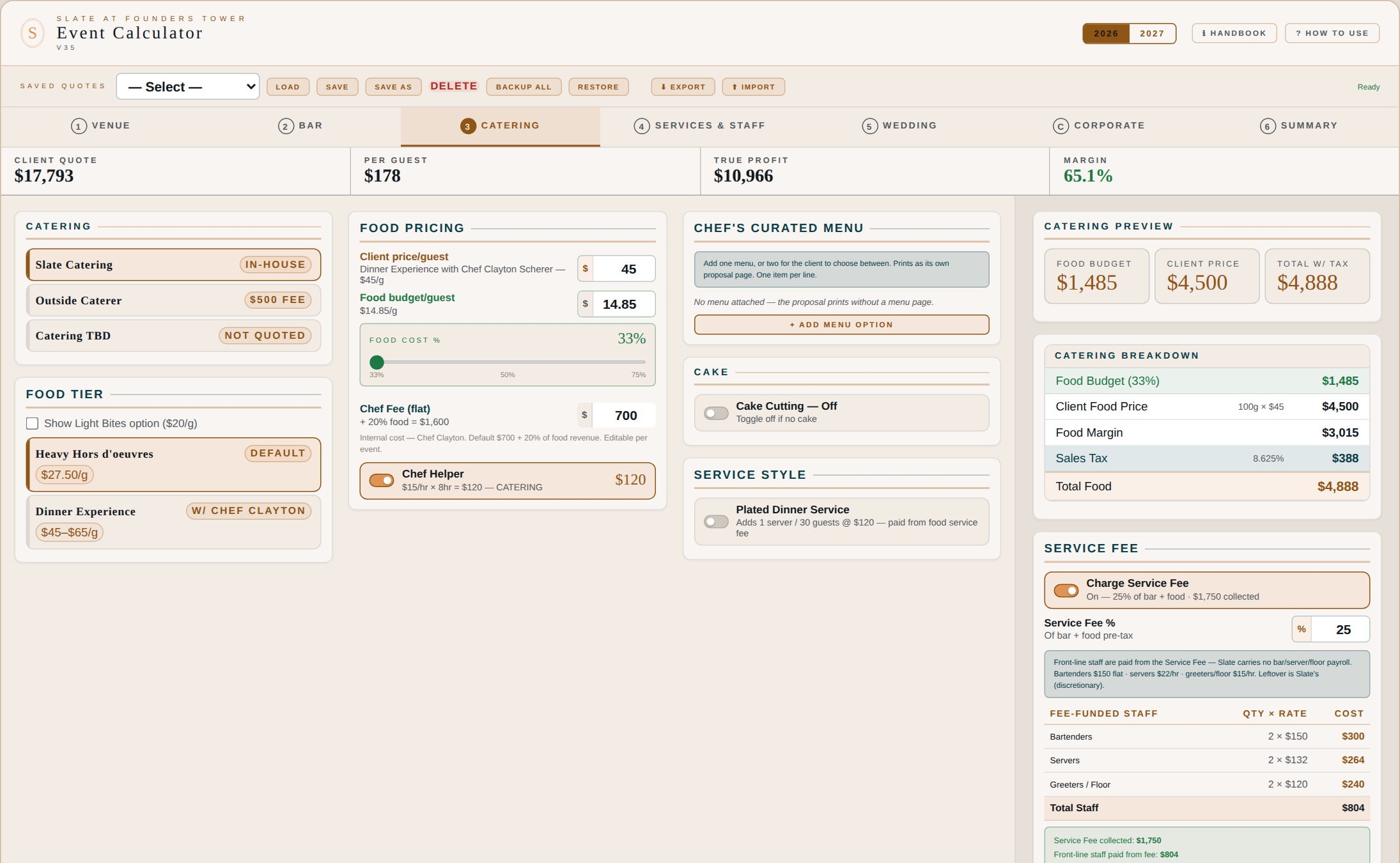
Slate catering, then the Dinner Experience with Chef Clayton at $45 a guest. The chef fee ($700 flat plus 20% of food) and the chef helper come along automatically. The 25% service fee sits on bar and food together and is what pays the floor staff.

Watch forCatering will read about 29%. That is structural, not a mistake in your setup — see the note at the end of this walkthrough.

Catering — Slate kitchen, Dinner Experience
Catering — Slate kitchen, Dinner Experienceclick to enlarge
4

Wedding — turn the package on

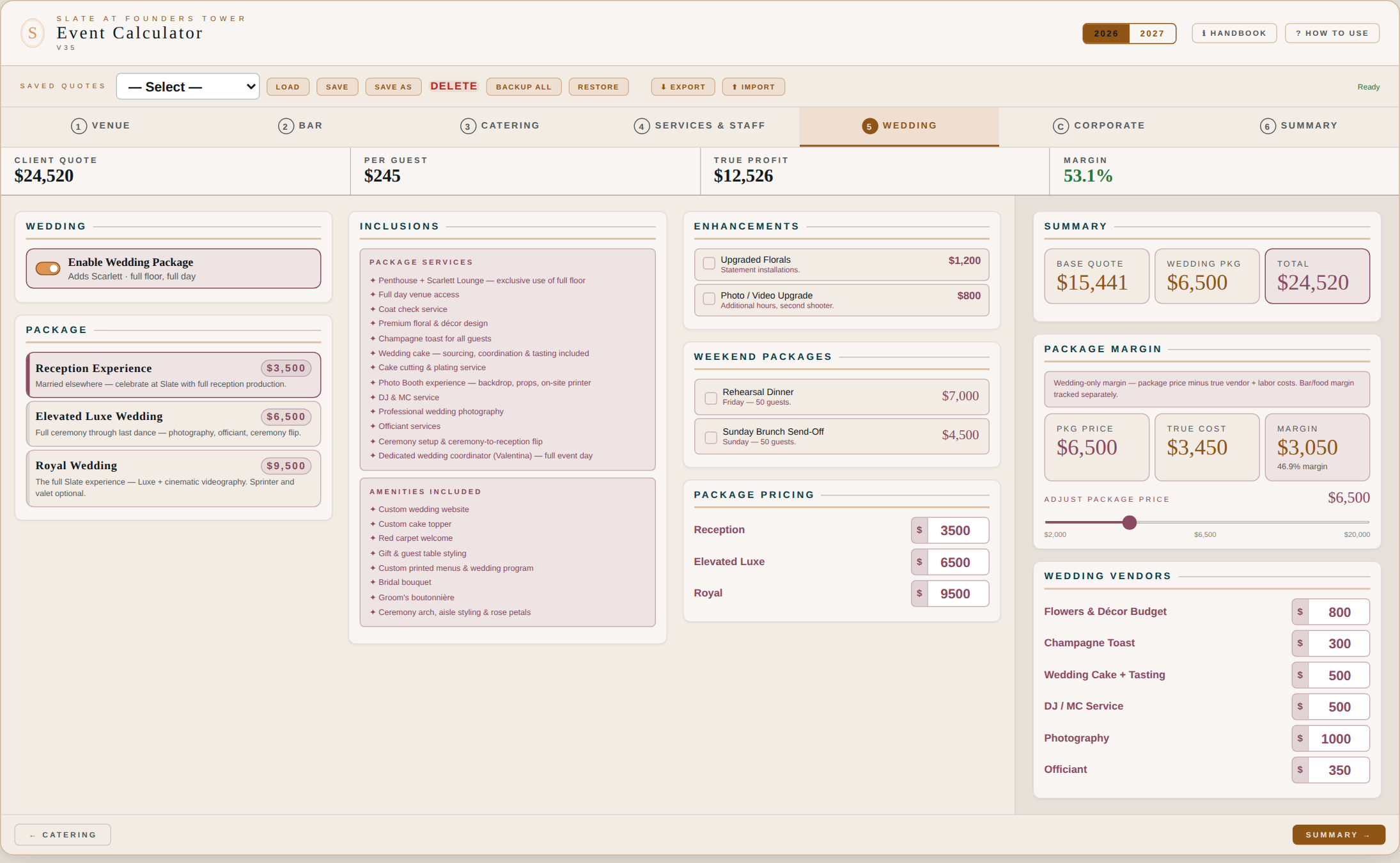
Switch on the Wedding Package and choose Elevated Luxe. Turning it on forces both lounges and full day, and seeds that tier’s execution budget: $800 of flowers, two people for eight hours to assemble them, thirty hours of Valentina’s planning time and a $500 allowance for coasters, menus and small items. All of it editable.

Watch forChoose the tier before you edit any of those numbers. Switching tiers resets them to that tier’s defaults.

Wedding — turn the package on
Wedding — turn the package onclick to enlarge
5

Summary — check it, then print

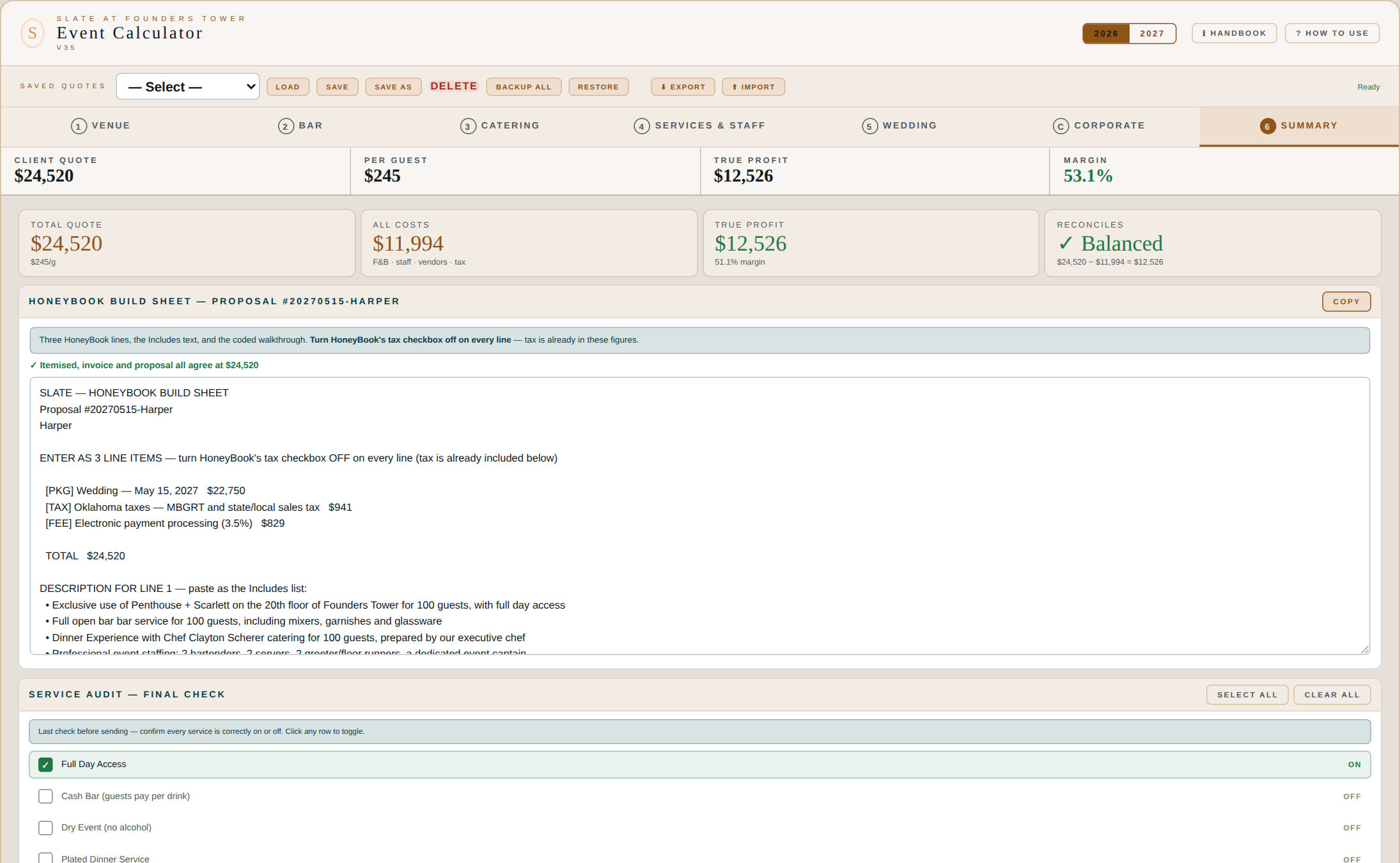
The quote lands at $24,520 with a true profit of $12,526 — a 51.1% margin. Read the cost centres before you send anything: Venue 94%, Bar 55%, Service Fee 71%, Wedding Package 24%, Catering 29%.

Print Proposal is the client document. Ops Brief is internal and never leaves the building. The build sheet gives you every line with its service code so you can rebuild the same invoice in HoneyBook.

Watch forOther / Unallocated should sit at or near zero. A large number there means something is being charged that no centre claims.

Summary — check it, then print
Summary — check it, then printclick to enlarge

Why the package reads low. At 24% the Luxe package is close to break-even by design — it exists to sell a $7,500 room that costs $450 to deliver. Judge the event, not the package.

Why catering reads low. The chef takes $700 plus 20% of food revenue, and food costs 33%. Those two together eat 53% of every catering dollar, so the ceiling is 47% no matter what you charge. Raising the menu price alone does not fix it.

B

A corporate mixer for 15 in Scarlett on a Tuesday

A small weeknight event, well under the 50-guest minimum. Worth walking through precisely because it shows what the minimum is for.

1

Switch to Corporate mode and set the basics

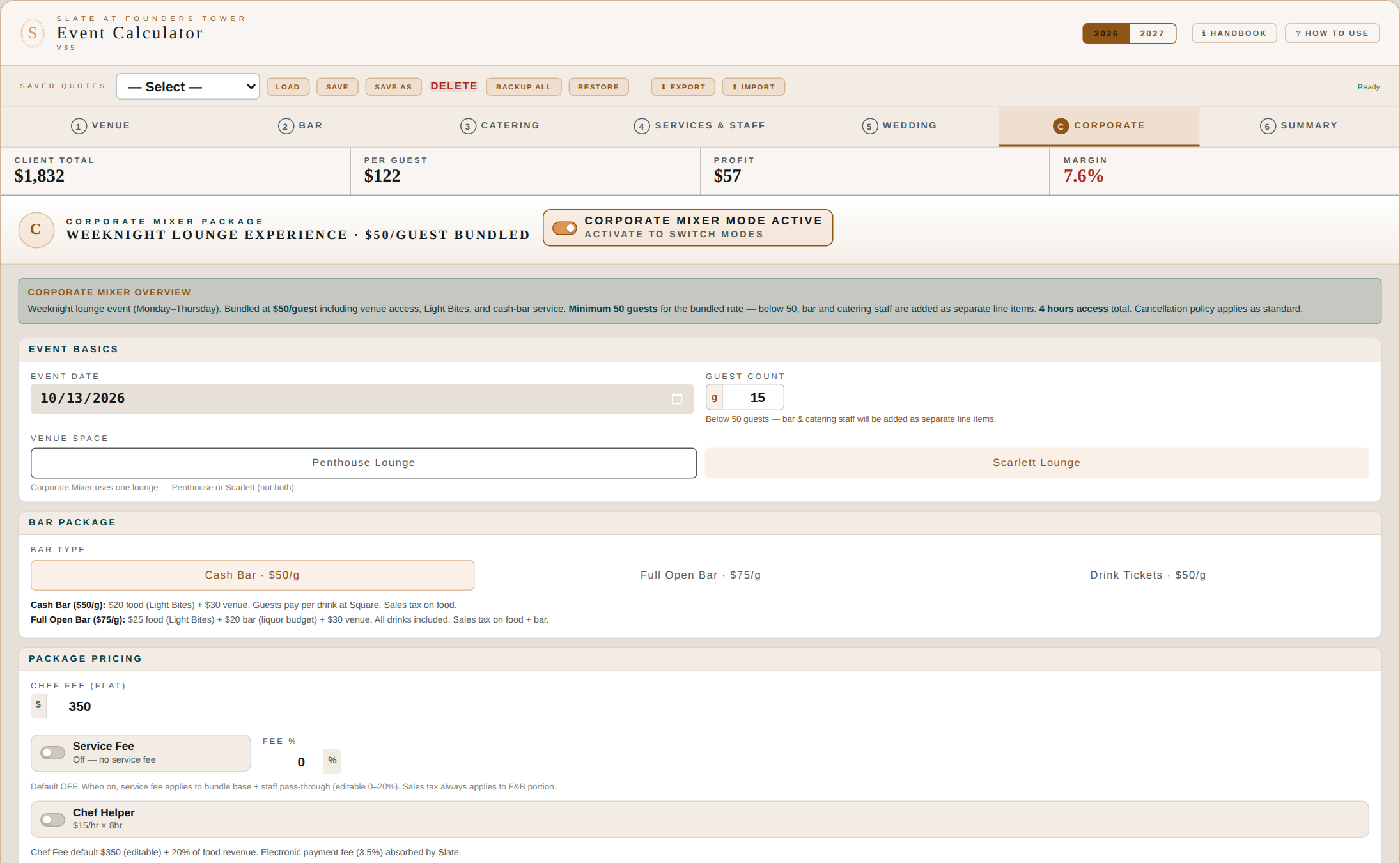
Corporate mode replaces the standard pricing model rather than adding to it. Set the date to a Tuesday, the space to Scarlett, and the guest count to 15.

The bundle is $50 a guest and covers venue access, Light Bites and cash-bar service for four hours. At 15 guests that is $750 of bundled revenue.

Watch forThe guest count is shared with the Venue tab — they are the same number, deliberately. Change it in either place.

Switch to Corporate mode and set the basics
Switch to Corporate mode and set the basicsclick to enlarge
2

Read what the minimum actually does

Below 50 guests the bundled rate stops covering the staff, and bar and catering staff come back as separate line items. Here that is $762 of staffing against $750 of bundle — the people cost more than the package earns.

The client pays $1,603.60, which is $106.91 a guest against a $50 headline. Slate keeps $64.87. That is a 4.0% margin.

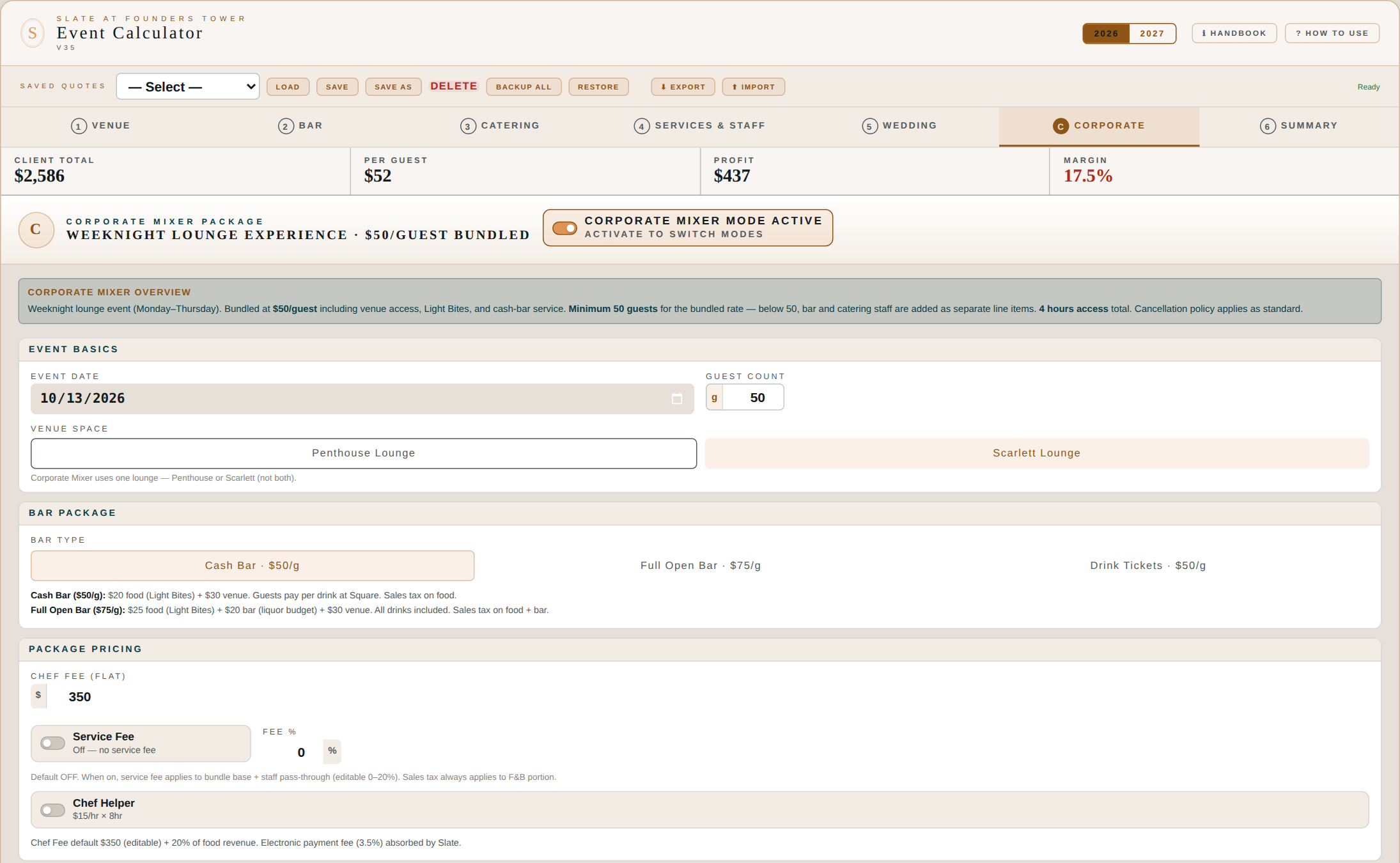
Watch forThe screen above shows the same event at 50 guests: $2,586.25 total, $51.73 a guest, $647.48 of profit, a 25.0% margin. That is the minimum doing its job.

Read what the minimum actually does
Read what the minimum actually doesclick to enlarge

What to tell a 15-person enquiry. The package is built for 50. Below that the staffing does not shrink — you still need a bartender, a server, floor staff and a captain for fifteen people as much as for fifty. Either bring the headcount up toward 50, or quote it as a standard event rather than the corporate package.

Worth knowing: even at the 50-guest minimum the corporate package runs at 25%, below the 40% target. It is a calendar-filler for quiet weeknights, not a margin product.

1

Venue

Who the event is for, when it happens, how many people are coming, and which rooms they get. Almost every other number in the tool keys off this tab.

Event Type

evt-typeDropdown
Sets the language used throughout the proposal. A wedding reads differently from a corporate mixer. Pick the closest match; it changes copy, not pricing.
themeText, optional
If the couple or company has a theme, it appears in the proposal narrative. Leave blank if there isn't one.
catonly-togToggle
Catering Only. Turn on when the client has already booked the room and is adding catering. The venue fee and bar drop to zero and every venue-side field greys out. Use it for an existing booking adding food, never for a new event.

Who's signing

rep-selDropdown
Pull a saved team member so you don't retype your details. Save a new one with the + button; remove with the trash.
rep / repTitle / repEmail / repPhoneText
The Slate person on the proposal. Whoever signs it should be the one listed.
cnameText
Client name. This drives the Proposal ID, which is formatted #YYYYMMDD-LastName. Spell it the way it should appear on the contract.
companyText, optional
Company or organization. Appears in the proposal when filled.

Tax and billing

taxex-togToggle
Tax Exempt. Removes sales tax from food and alcohol. Only for entities with a valid Oklahoma exemption — universities, churches, government. Record the entity and the permit number in the two fields it reveals. Liquor gross receipts tax is NOT removed, because that tax is levied on Slate as the licensee, not on the customer.
po-togToggle
Institutional / PO Billing. For clients paying by purchase order and check instead of card. Turns off the card processing fee and changes how the date is secured. Fill in the PO number and net terms.

Date and guests

edateDate
Event date. Setting it auto-selects the day of the week, which sets the day premium. Saturday carries a 100% premium, Friday 50%, Thursday and Sunday 25%, Monday through Wednesday none. Always set the date rather than picking the day by hand.
mdateDate
Meeting date — when you sat down with the client. Informational.
guestsNumber
Total guest count. Drives catering, bar, staffing and minimums.
drink-guestsNumber
Drinking Guests. Defaults to the total. Override it when a meaningful share won't drink — a wedding with many children, a dry-adjacent crowd. Bar revenue and liquor budget both follow this number, not the total. Reset returns it to the total.

Space and duration

Space choiceButtons
Penthouse, Scarlett, or both. Both means exclusive use of the full floor and is what wedding packages assume.
fullday-togToggle
Full Day Access. Adds the full-day supplement and extends the Event Captain from 8 hours to 15. Weddings are normally full day.
valet-master-togToggle
Valet Parking. Slate does not run valet — we introduce the operator and pass their price through at cost, so it nets to zero for us. Turn it on and the client is charged exactly what the vendor is paid. It is never bundled into a package and never absorbed by Slate.
2

Bar

How alcohol is served and what it costs. The three service models — open bar, cash bar, drink tickets — can combine.

Service model

Experience TierButtons 1/2/3
Tier 1 Beer & Wine $15/guest. Tier 2 Full Open Bar $25/guest. Tier 3 Premium Open Bar $40/guest. The tier sets a default price per guest which you can then override.
bar-cpNumber
Client bar price per guest. What the client pays. Changing the tier resets this; edit after choosing the tier.
bar-bdNumber
Liquor budget per guest. What Slate expects to spend on product. Defaults to 33% of the client price. This is the number that sets the Bar cost center's margin.
bar-sldSlider
Drags the client price. Same field as bar-cp, easier for live conversations.

Alternatives to open bar

cashbar-togToggle
Cash Bar. Guests pay per drink at the point of sale. Slate collects no bar revenue up front, so the bar cost center is excluded from margin scoring. A bar staff fee is still charged.
tickets-togToggle
Drink Tickets. The host prepays a block of tickets guests redeem; anything beyond is cash bar. Turning tickets on turns cash bar on automatically, because that is what happens once the tickets run out.
ticket-qty / ticket-priceNumber
How many tickets and what each is worth. Default $9. Tickets are a liquor sale, so alcohol sales tax, gross receipts tax and the service fee all apply.
ticket-descText
What the ticket covers — 'beer, wine or house cocktail'. Appears on the proposal.
dry-togToggle
Dry Event. No alcohol at all. Zeroes bar revenue and liquor budget. Bartenders become a pass-through charge rather than a fee-funded cost.
3

Catering

Who cooks, what they serve, and how the service fee that pays the floor staff is calculated.

Who caters

cat-slate / cat-out / cat-tbdButtons
Slate catering, outside caterer, or undecided. Slate catering brings food revenue, food cost and the chef fee. Outside catering replaces all of that with a coordination fee.
outcater-feeNumber
Coordination fee for an outside caterer. Follows the space automatically — $500 Penthouse, $250 Scarlett, $500 for both — and is editable.

What's served

tier-light / hors / dinnerButtons
Light Bites $20/guest. Heavy Hors d'oeuvres $27.50/guest. Dinner Experience with Chef Clayton $45/guest, with a stated range of $45 to $65 depending on the menu.
food-cpNumber
Client price per guest. The tier sets it; override after choosing.
food-bdNumber
Food budget per guest — Slate's expected cost, default 33% of the client price.
chef-fee-flatNumber
Chef's flat fee, default $700, plus 20% of food cost on top. Both land in the Catering cost center.
chefhelper-togToggle
Chef Helper. $15/hr for 8 hours, auto-added with Slate catering. Charged to Catering.
cake-togToggle
Cake cutting and plating service. Turn off if there's no cake.

Service style and the service fee

plated-togToggle
Plated Dinner Service. Adds one server per 30 guests at $120 each, paid out of the food portion of the service fee. Anything the fee can't cover, Slate absorbs.
srv-rate / srv-hrs / srv-up / srv-dnNumber
Server pay rate, hours and headcount. Default $22/hr for 6 hours.
svcfee-togToggle
Charge Service Fee. On by default.
svcfee-pctNumber
Service fee percent, default 25%, charged on bar and food pre-tax. This is not a gratuity and is not distributed as one — it funds bartenders, servers and floor staff. Whatever is left over, Slate keeps.
4

Services & Staff

Everything that applies across the whole event rather than to bar or catering alone — discounts, protection, security, valet, décor labor and planning time.

Discount and protection

disc-tog / disc-pctToggle + number
With Slate's Compliments. A courtesy discount off the venue fee only, capped at 15%. It reads as a gift on the proposal rather than a negotiated price cut.
prot-tog / prot-pctToggle + number
Event Protection. An optional charge recovering Slate's own risk exposure, calculated on the venue fee plus the alcohol package. Deliberately not called insurance — Slate is not a licensed producer and selling coverage would be a different business.

Security and valet

security-master-togToggle
Security Service. $250 flat per guard. It is a pass-through — the client pays it and Slate pays the guard, so it nets to zero.
valet-amt-inpNumber
What the valet operator charges. The same figure is billed to the client and paid to the vendor.

Décor labor and planning

decorlabor-togToggle
Décor Labor. The people who physically assemble and place flowers and décor.
decorlabor-rate / decorlabor-hrsNumber
Rate and hours per person, default $15/hr for 8 hours.
decorlabor-up / decorlabor-dnButtons
How many people. Wedding tiers default to 1 for Reception, 2 for Luxe, 3 for Royal.
val-rate / val-hrsNumber
Valentina's planning and coordination time, default $25/hr. Wedding tiers default to 20, 30 and 40 hours. On a wedding these costs land in the Wedding Package cost center; on any other event décor labor lands in Venue.

Staffing roster and add-ons

Staffing tableTable
One row per role. The left columns — pay rate, hours, headcount — are what Slate pays and never appear on the proposal. The Client $ column is what the client is billed when a role bills through. Both sides are editable and independent.
cust-nm / cust-prText + number
Add a custom add-on with its own name and price.
5

Wedding

The wedding package layer. It sits on top of the venue, bar and catering already configured on the other tabs.

Package

wed-togToggle
Wedding Package. Turning it on forces both lounges and full-day access, and seeds the execution budget for the chosen tier.
reception / luxe / royalButtons
Reception Experience $3,500. Elevated Luxe $6,500. Royal Wedding $9,500. Switching tiers resets the flower budget, décor headcount and planning hours to that tier's defaults, so choose the tier before editing those numbers.
w-pkg-sliderSlider
Moves the package price and shows the resulting package margin live.

What each tier includes

Reception Experience$3,500
Full floor, full day, coat check, floral and décor design, champagne toast, cake with tasting and cutting, photo booth, DJ and MC, and Valentina for the event day.
Elevated Luxe$6,500
Everything in Reception, plus professional photography, officiant, ceremony setup and the ceremony-to-reception flip, premium florals, bridal bouquet, boutonnière and aisle styling.
Royal Wedding$9,500
Everything in Luxe, plus cinematic videography, statement floral installations, a premium cake and full-evening champagne service. Sprinter transport and valet are available as arranged extras — neither is included.

The execution budget

Flowers & DécorAllowance
$500 Reception, $800 Luxe, $1,200 Royal. This is what Valentina may spend on everything floral — reception styling, bouquet, boutonnière, arch, aisle and petals.
Décor LaborCost
1, 2 or 3 people by tier, 8 hours each at $15/hr.
Valentina — PlanningCost
20, 30 or 40 hours by tier at $25/hr.
Miscellaneous Allowance$500
Coasters, printed menus, cake topper and other small items. One allowance rather than a dozen line items.
C

Corporate

A separate, simpler pricing mode for weekday corporate events. It replaces the standard model rather than adding to it.

Mode

corp-mode-togToggle
Switches the whole tool into corporate pricing. The standard cost centers are replaced by corporate equivalents.
corp-guestsNumber
Guest count. There is a 50-guest minimum — smaller events are penalized by design, to keep the package worth running.
corp-dateDate
Event date. Corporate packages are Monday to Thursday only and excluded in December. Scarlett runs Monday to Thursday, Penthouse Monday, Tuesday and Thursday, because Wednesday is reserved for the public happy hour.

Drink tickets

corp-tick-perNumber
Tickets per guest, prepaid by the host.
corp-tick-priceNumber
Value of each ticket — a ceiling, not a fixed price. A guest ordering under it doesn't get change; over it, they pay the difference.

Food, fee and staff

corp-chef-flatNumber
Chef's flat fee for the corporate package.
corp-svcfee-tog / corp-svcfee-pctToggle + number
Service fee on the corporate package.
corp-chefhelper-togToggle
Chef helper. Its cost is deducted from corporate profit.
corp-staff-*Number
Headcount per role for the corporate event.
corp-comp-tog / corp-comp-pct / corp-comp-flatToggle + number
A courtesy discount, either a percentage or a flat amount.
6

Summary

Where you check the work and produce the documents. Nothing here changes pricing — it reports it.

Outputs

Print ProposalButton
The client-facing document. Six parts: cover letter, the evening described, what's included, the investment, the agreement to sign, and the fine print. Carries a 7-day expiry.
Ops BriefButton
The internal document. Every cost, every margin, the staffing roster and the cost center breakdown. Never give this to a client.
inv-textTextarea
The HoneyBook build sheet — every line item with its service code, ready to paste. Codes like VEN-RENT, BAR-STAFF and WED-LUXE let you rebuild the same invoice line by line in HoneyBook.
Save / Load / ExportButtons
Saves live in the browser and survive version updates. Export writes a file you can keep or move to another machine.

Payment plan

pmt-togToggle
Custom Payment Plan. Off means the default 40/30/30 split.
pmt-cntNumber
How many payments, 1 to 10. Each row's percentage and due date is then editable.

Reading the margins

Cost centersDisplay
Venue, Bar, Catering, Service Fee, Wedding Package and Card Processing. Each shows revenue, expense and margin. The target is 40%.
Card ProcessingDisplay
Always reads 0%. The fee is collected from the client and paid straight to the processor, so it nets to zero by design.
Other / UnallocatedDisplay
A residual — anything no named center claimed. On a standard wedding it should be zero or close to it. A large number here means something is being charged that isn't mapped to a center.
§

Glossary

The terms that appear on the Ops Brief and in the cost centers.

Cost center
One slice of the event with its own revenue and its own costs, so you can see which parts pay for themselves. Venue, Bar, Catering, Service Fee, Wedding Package and Card Processing. The target for each is 40%.
Other / Unallocated
A residual bucket — anything no named center claimed. It exists so the math always reconciles. On a normal event it should be at or near zero; a large number means something is being charged that is not mapped to a center.
Service fee
25% of bar and food pre-tax. It funds bartenders, servers and floor staff. It is not a gratuity, is not distributed as one, and whatever remains after paying the floor, Slate keeps.
Pass-through
A charge collected from the client and paid straight out, netting to zero for Slate. Security and card processing are the two main ones.
Day premium
A multiplier on the venue fee set by the day of the week. Saturday 100%, Friday 50%, Thursday and Sunday 25%, Monday to Wednesday none. It follows the event date automatically.
MBGRT
Oklahoma's mixed beverage gross receipts tax, 13.5% on liquor. It is levied on Slate as the licensee rather than on the customer, which is why a tax-exempt client does not escape it.
Liquor budget
What Slate expects to spend on product, defaulting to 33% of the client bar price. It sets the Bar cost center's margin.
Drinking guests
The subset of the guest list who will be served alcohol. Defaults to the total; override it when a meaningful share will not drink.
Execution budget
On a wedding, the flowers allowance plus décor labor plus Valentina's planning hours plus the miscellaneous allowance. What that wedding may spend to deliver what was promised.
Proposal ID
The tracking number on every proposal, formatted #YYYYMMDD-LastName from the event date and the signing client's surname.
Ops Brief
The internal document — every cost, margin, roster line and cost center. Never give it to a client.
Catering Only
A mode for a client who already booked the room and is adding food. Venue and bar drop to zero and their fields grey out.
Slate at Founders Tower · internal reference for the Event Calculator v35. Figures shown are defaults; every one is editable per event.